If you live with hypermobile Ehlers-Danlos syndrome (hEDS), postural orthostatic tachycardia syndrome (POTS) or mast cell activation syndrome (MCAS), there is a good chance you have come across the other two.
These three conditions are often found together. When conditions occur alongside each other like this, they are known as comorbidities, and in clinic and in online communities this particular combination is often called "the trifecta".
I have seen this overlap regularly in my clinical practice, so in this article I want to look at what is known about the link, what the possible mechanisms are and what may help.
What are hEDS, POTS and MCAS?
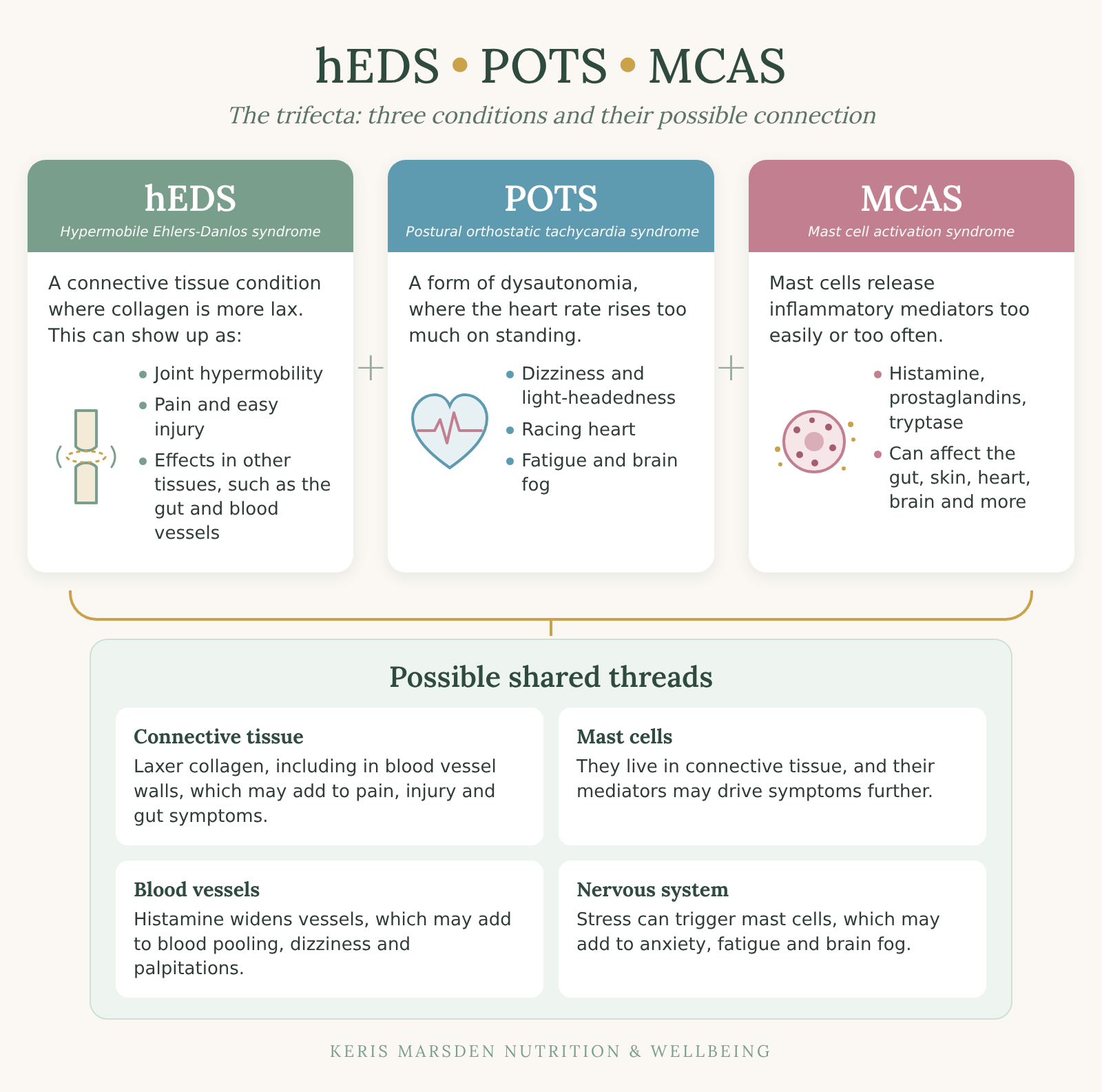
Hypermobile Ehlers-Danlos syndrome (hEDS) is a connective tissue condition. Collagen, the protein that gives our tissues their strength and structure, is more lax, which can show up as joint hypermobility, pain, easy injury and problems in tissues throughout the body including the digestive system.
Postural orthostatic tachycardia syndrome (POTS) is a form of dysautonomia, where the autonomic nervous system struggles to regulate heart rate and blood flow. When you stand up, your heart rate rises excessively, often with dizziness, light-headedness, fatigue and brain fog.
Mast cell activation syndrome (MCAS) is where mast cells, part of the immune system, release numerous inflammatory mediators such as histamine, prostaglandins, leukotrienes and tryptase too easily or too often. This can cause symptoms across many body systems, including gut, skin, cardiovascular system and nervous system.
Where does the evidence stand?
Currently there are no NICE or NHS guideline that recognises this trifecta as a defined clinical condition, and there is no agreed clinical definition of how the three are linked. That does not necessarily mean the link is not real, but the research is still catching up with what patients experience and clinicians are seeing.
In the UK, charities such as Ehlers-Danlos Support UK, whose GP toolkit was developed with the Royal College of General Practitioners, and PoTS UK both recognise POTS and MCAS as frequently associated with hEDS.
Research is ongoing to establish how and why they are connected.
The research is inconclusive, a 2019 review by Kohn and Chang argued that the evidence for a shared mechanism is lacking. More recently, a 2025 paper in Frontiers in Neurology found a strong overlap between POTS and MCAS, although how strong depended heavily on which diagnostic criteria were used.
In the US, the American Gastroenterological Association published a Clinical Practice Update in 2025 on managing gut symptoms in people with hEDS alongside POTS and/or MCAS, which shows how seriously the overlap is now being taken.
Possible links: hEDS, POTS and MCAS?
Nobody has found a single common cause yet, but there are several theories. In my view they are most helpful seen as multiple imbalances possibly linked by the nervous and immune system.
1. Connective tissue dysfunction
In hEDS, collagen is more lax, and that includes the collagen in the walls of our blood vessels. Less supportive vessel walls may make it harder for the body to keep blood moving back up towards the heart and brain.
2. Mast cells in connective tissue
Mast cells live in connective tissue. When they release inflammatory mediators, some of these can break down connective tissue further. This can create a vicious cycle, where tissue that is already vulnerable becomes more inflamed and less robust.
3. Histamine and the blood vessels
Histamine and prostaglandins widen blood vessels and can lower blood pressure. Combine that with lax vessel walls and you may get blood pooling in the legs when you stand. The heart then has to work harder to compensate, which drives the racing heart that is the hallmark of POTS.
4. The nervous system
There is also a two way relationship between mast cells and nerves. Mast cells sit right beside nerve endings, and stress signalling from the nervous system can trigger them to release their mediators, which in turn affects the nerves. This is one of the reasons I place so much emphasis on nervous system support. Dysautonomia and small fibre neuropathy can also be part of this process.
5. A possible genetic thread
Hereditary alpha-tryptasemia is a genetic trait where people carry extra copies of the gene for tryptase, one of the mediators mast cells release. A 2016 paper in Nature Genetics linked it to hypermobility, dysautonomia and mast cell symptoms, although later studies have been mixed.
What I see in clinic
These are my clinical observations rather than established research, but I have seen some recurrent patterns.
Many people I work with who have the trifecta have lived very stressful lives, with some of adverse childhood experiences (known as ACE’s in the research) and adult traumas.
By the time they reach my clinic they’ve often experienced what’s known as the perfect storm where unexpected life events, stress load and infections pushed their body into a state of hyperreactivity and illness.
Their symptoms may also have been present from a young age including recurrent injuries, chronic infections, intolerances and hormone issues. Many have also had a lot of medical treatments, such as repeated courses of antibiotics. Antibiotics change the gut microbiome, and this may shift the balance of bacteria that break down histamine, which could be one reason gut symptoms are so common in this group.
They lead very busy lifestyles (many Type A personalities) often caring for others. Many are prone to perfectionism and hyper resilient so rarely make time for rest, relaxation, fun or creativity. They are super kind, caring to others yet rarely have time to meet their own (true) needs.
Stress and the nervous system also affect gut transit time, which can change how strongly histamine related symptoms are felt.
Some have used a lot of exercise to cope with stress, which places repeated mechanical strain on both the gut and joints.
Many have been invested in healthy living for some time but to the point it’s causing pressure and fear around not being able to maintain a certain standard or control aspects of their nutrition or fitness. Injuries and illness feel very threatening to them.
A dysregulated nervous system and anxiety is often present in all three conditions.
What helps: a personalised plan
There is no one size fits all approach, but these are the three areas I focus on with clients.
1) Supporting tissue integrity
Strengthening tissue integrity also supports joint integrity and reduces the risk of injury and further tissue damage from high impact and repetitive movement.
Nutrition: a higher protein diet, aiming for at least 1.5 g of protein per kg of body weight where possible, rich in glycine and vitamin C to support collagen formation.
Movement: build strength gradually with low injury risk exercise, staying mostly below your anaerobic threshold, as pushing into high intensity can trigger POTS symptoms or simply dizziness in some people. Seated or lying exercises are a good starting point if being upright triggers symptoms.
Diet and mast cell support
A diet rich in anti-inflammatory and antioxidant nutrients is helpful, but it needs to be personalised to what you tolerate, as some people with MCAS have many food allergies or reactions.
Natural antihistamine and mast cell support: quercetin, luteolin, vitamin C to support histamine clearance, DAO enzymes, and Chinese skullcap (Scutellaria baicalensis), which is often used in gut health formulas.
Anti-inflammatories: omega-3s, and possibly some turmeric and ginger.
Gut support: possibly low histamine probiotics, such as HistaminX by Seeking Health.
Always check with your GP or prescriber before starting supplements, especially if you take medication.
A nervous system programme
This is the piece I think matters most, and I think it’s important to include some education. There are many myths and misunderstandings about the nervous system. Many people try to force regulation with breathwork, cold showers or tapping (emotional freedom technique, EFT). But sometimes more allowing and neutrality is needed to really reassure the nervous system that we are safe, rather than reacting to every sensation we notice.
Our emotions are also tightly linked to our nervous system. They are part of the body’s survival mechanism: fear helps us escape danger, and anger helps us protect and defend ourselves and put boundaries in place. If we repress our emotions, the nervous system is likely to need to work harder to protect us. That’s why I think this educational piece is so important.
Alongside this, there are some simple tools we can build into our day to keep the body in balance, and strike a healthier balance between human doing and human resting. The tools I often recommend include some dedicated time out for emotional allowing and somatic practices, and then nervous system support built into your daily routine, such as non-sleep deep rest (NSDR) and yoga nidra, qigong, somatic meditations and journaling.
Final thoughts
The link between hEDS, POTS and MCAS is still being worked out, and it is likely to be a loop between connective tissue, mast cells and the nervous system rather than one single cause. While the research catches up, there is a lot you can do to support your tissues, calm your mast cells and help your nervous system feel safer.
If you recognise yourself in this and would like personalised support, I work with clients with MCAS, histamine issues and related conditions. You can book a private consultation to get started.