

Cromolyn: The MCAS GI Medication Nobody Offered Me
Of everything I've tried for my MCAS, one medication has made more difference to my day to day life than almost anything else.
It's called cromolyn sodium (in the UK you'll often see it written as sodium cromoglicate), and most people have never heard of it. So I wanted to share a little of my story, a brief history of this medication, how it works, where people get it, and how I started taking it.
My gut story
I've had IBS since my early twenties. Over the years I tried most of what's out there: low FODMAP, probiotics, prebiotics, digestive enzymes, treatments for small intestinal bacterial overgrowth (SIBO), going gluten and dairy free, and paleo.
Alongside the diets and supplements, I was offered a long list of medications for my gut. These included Buscopan and peppermint oil for spasms and cramping, omeprazole to reduce stomach acid, the antidepressants sertraline and nortriptyline (which are often used at low doses in IBS to calm gut sensitivity), prokinetics such as domperidone and prucalopride to speed up gut movement, the antibiotics rifaximin and neomycin for SIBO, and bile acid sequestrants like cholestyramine.
Then, after a period of burnout and a couple of rounds of COVID, things got a lot worse. I developed gastritis, severe bloating, and reflux and silent reflux. And I started reacting to more and more foods, as my whole system became more and more sensitive.
Medication as a stabiliser, not the whole answer
I want to be clear about something before I go any further. I'm under no illusion that the biggest root cause of my symptoms is stress. Not just the external stressors, but also the fact that for a long time I didn't have a good understanding of the internal side of health: emotional balance, my own coping mechanisms, and my habit of keeping busy, working hard and staying in a mobilised, always doing state, exercise included.
So I see medications and supplements as something we can use to support the body when it falls into a state of dysregulation.
That imbalance might be immune based, hormonal or nervous system based, and very often all three are working together and influencing one another. While we do the deeper work, it's really helpful to think about how we can stabilise the system. For me, cromolyn has been one of the most useful tools for doing exactly that.
A brief history of cromolyn
I was curious why something so effective wasn't offered to me by any of the eight gastroenterologists I consulted over the seven years I was so unwell.
Turns out cromolyn has an interesting backstory, and it started with a herb. Khella (Ammi visnaga) is a plant that has been used in Egyptian and Middle Eastern traditional medicine for centuries, for things like cramps, colic and breathing problems. Its active compound, khellin, relaxes smooth muscle, but it also caused side effects such as nausea.
In the 1960s, Roger Altounyan, a British doctor and researcher who had asthma himself, set out to find a version of khellin that worked without the downsides. He tested hundreds of related compounds on his own lungs, and cromolyn was the result: a medication that evolved from the herb but with far fewer side effects.
It was launched in the UK in 1968 as an inhaler for asthma, and through the 1970s and 1980s it was widely used for asthma and allergies. An oral version was also used for food allergy and gut symptoms.
It was fairly quickly overtaken by newer medications, such as inhaled steroids, and today it's rarely used. Which is a shame, because for people with mast cell issues it can be incredibly helpful.
How it works
Cromolyn is a mast cell stabiliser. Mast cells are immune cells that sit in the lining of the gut (and the skin, airways and elsewhere), and when they're overactive they release histamine and other inflammatory mediators in response to things like food.
When you take cromolyn by mouth, very little of it is absorbed into the bloodstream. It stays in the gut and works locally on the gut lining, which is why people often describe it as coating the stomach. It helps calm the mast cells there, so they release fewer mediators when you eat.
Because it isn't working on the body systemically and doesn't cross the blood brain barrier, it doesn't make you drowsy or foggy. That matters to me. I'm still doing work that needs me to be present and aware, and cromolyn isn't overriding my system. It's simply giving it a bit of a buffer.
It's also a preventative medication. It's taken before meals to reduce reactions, rather than to treat a reaction once it's happening.
Where people get it
Cromolyn comes in a few different forms, and what's available varies a lot by country.
In the UK, you can buy cromolyn eye drops over the counter for allergies and histamine reactions. Sadly the inhaler has been discontinued in the UK.
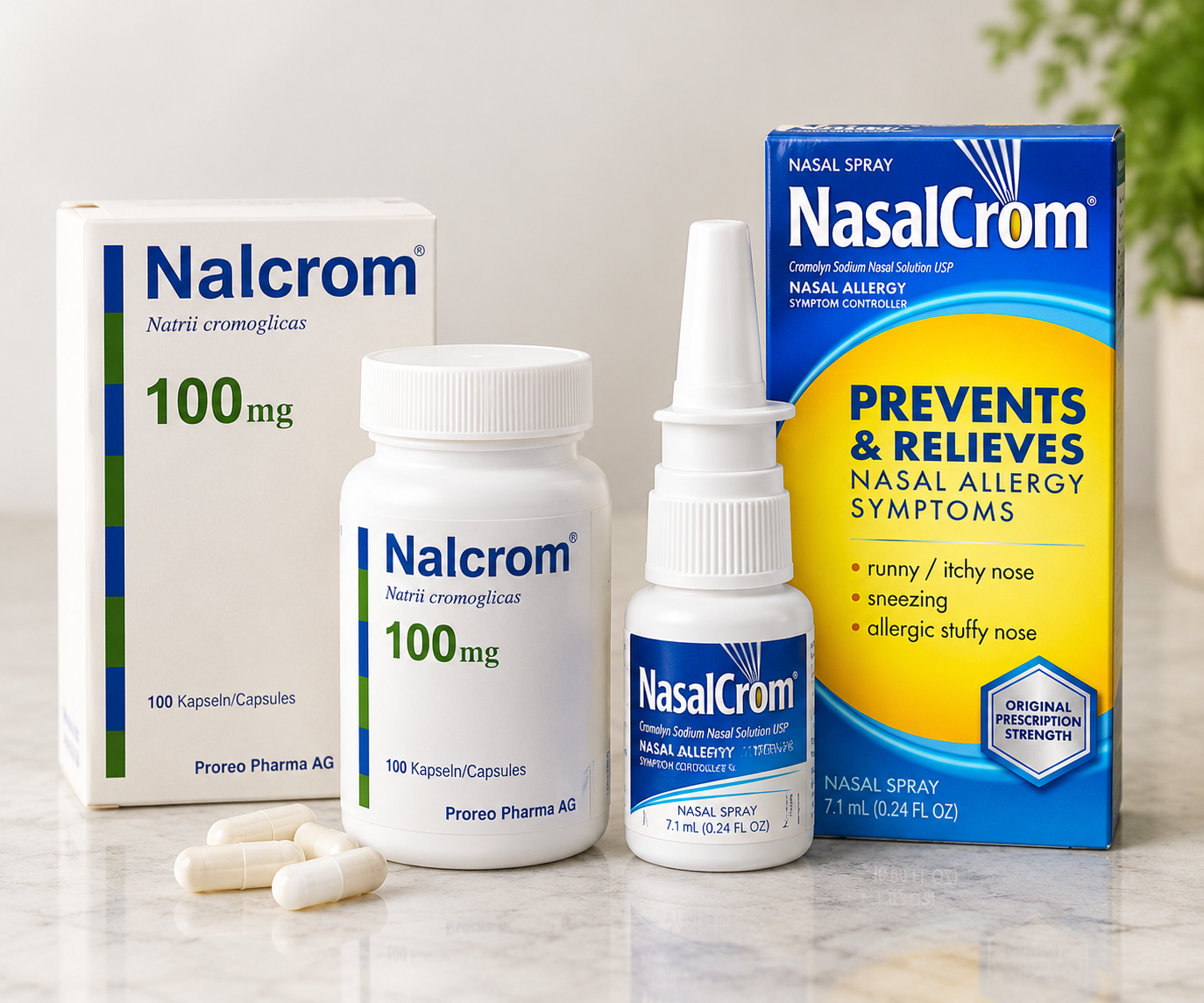
The branded oral capsules (Nalcrom) are no longer distributed here either, but generic sodium cromoglicate capsules are still available on prescription.
In Germany, many people buy capsules called Pentatop over the counter at the pharmacy. These contain the usual capsule ingredients alongside the cromolyn, such as gelatine, fillers and colourings.
In the US, it's prescribed as an oral liquid in single dose ampoules, which you drink.
For me personally, I was prescribed compounded cromolyn by the MCAS clinic in Glasgow. These are capsules with no excipients, so very little in them but the cromolyn, which suits a very sensitive system.
How I started
As with any sensitive system, it's possible to react to anything, including cromolyn. So I started very low and slow.
I opened a capsule, took about a quarter of the contents mixed into water, and did that for 7 days. I had no adverse reactions, so after about a week I built up to emptying a whole capsule into a little water and taking that before a meal.
The usual advice is to take it around 30 minutes before eating. I'll be honest, sometimes I forget, and I still notice a big benefit.
Please work with your prescriber on how to start and how much to take. What suits me won't necessarily suit you.
What changed for me
The first thing I noticed was less bloating and less pain.
I've also been taking ebastine alongside it. This is an antihistamine that works on the H1 receptors, and there are trials suggesting it may help with IBS symptoms, particularly abdominal pain, although it isn't licensed for IBS.
Together, the two have dialled down a lot of the pain and discomfort around food. That has meant I've been able to:
Eat enough. I was underweight after my last round of COVID, and being able to eat properly again has been huge.
Get my iron levels up, including finally being able to tolerate iron supplements.
Introduce many more foods, at a time when my list of safe foods was getting smaller and smaller.
And maybe most importantly, stop thinking about food all the time. Every meal used to come with a wave of stress about whether I was going to react. Taking that away has freed up so much headspace to focus on the other things I needed to deal with.
So why isn't it offered more?
I'm honestly still confused about why cromolyn isn't offered more often. It has a good safety profile and has been around for decades.
Part of the answer is licensing. Oral cromolyn is licensed in the UK, but only for food allergy. It isn't licensed for MCAS or IBS, so prescribing it for gut symptoms like mine is off label.
Many GPs understandably feel uncomfortable doing that without a specialist's recommendation, which is why lots of people end up getting it through specialist clinics or buying it abroad.
The branded capsules, Nalcrom, were withdrawn from the UK in 2023 after years of patchy supply. Today the capsules are prescribed as generic sodium cromoglicate 100mg, with no well known UK brand name. The eye drops are easier to find, sold over the counter in pharmacies under names such as Opticrom.
Supply chain problems and funding seem to be the other big reasons. As an old, off patent medication, there's little commercial interest in championing it, or in running the trials that would be needed to license it for conditions like MCAS.
It does seem a shame. I know many people who could potentially benefit from it, given how safe it is. Maybe, with more awareness and more demand, that will change in the future.
If you live with MCAS or histamine related gut symptoms and cromolyn sounds like something worth exploring, take this to your GP or specialist and have a conversation about whether it could be right for you.
This article shares my personal experience and is for information only. It isn't medical advice. Please speak to your doctor or prescriber before starting or changing any medication.