I'm seeing so much nervous system dysregulation in my practice right now. So many people are living on high alert, overwhelmed and exhausted, and trying everything to feel calmer, without really understanding what their system needs to feel safe.
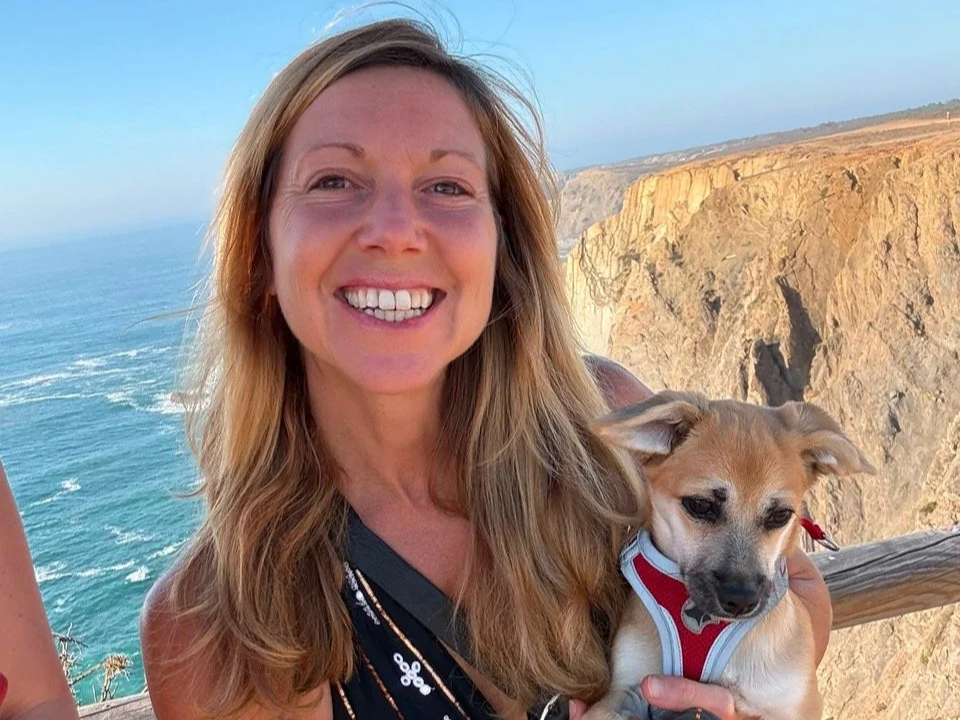
So I wanted to share a story that shows this better than any explanation I could give: the journey I've been on with Poppy, our little rescue pup.
Safety and trust
Poppy was abandoned at just 5 weeks old, so understandably her nervous system was on high alert when she came into our lives. It's taken her time to be able to trust that she's loved and cared for unconditionally.
Her journey to me was preceded by the care of two incredible women. One discovered her and the other fostered her initially, so from the very beginning she responded with more receptivity to women than to men.
And then came Matt, this mountain of a man who might have appeared intimidating at first to a tiny, frightened puppy, but who showed her nothing but kindness, cuddles and play. Together we've been able to provide her with a secure attachment, and from that place of safety she's become more curious and now feels safe to explore the world around her.
When we spend time with her, as much as possible, we consciously put away our phones so she gets our full attention, including eye contact, our voices acknowledging her presence, and physical play. And Hamish gets an equal amount for all his efforts. Huge props to Hamish, who has opened up his space to her and cared for her with so much awesome bro kindness.
What she's mirrored back to me
Everything I've learned about the nervous system over the years, I've been able to apply practically with her. And of course, she has mirrored so many lessons back to me.
Just like us humans, we can see she becomes overstimulated quickly. Too much noise, a huge amount of visual stimulus, lots of smells and, most importantly, a lack of rest, and she changes. She becomes more reactive, more distrusting, almost paranoid, and really averse to physical contact.
Sound familiar? I know I can recognise a version of that in myself, and in so many of the clients I work with.
So we've stuck to a consistent routine that gives her a good amount of rest back in her little cave, and we pop her in there even when she's resistant. More often than not, she emerges a completely different version of herself.
And honestly, Matt and I aren't so different. If we stack our day too intensely, we come out of work just like Poppy: hungry, reactive, irritable and unable to sit still. That's why one of the biggest takeaways for me has been giving ourselves mini breaks across the day. Little pockets of time to decompress and allow the nervous system to regulate, so we can step back into the stimulation of work and life with more resources in the tank.
Co-regulation
She now joins Hamish and me when I sit to meditate or do a yoga nidra. I bundle her up in the duvet to encourage her to surrender into rest, and because we are still, she submits. You can physically see her let go and then relax.
She loves to rest her head on Hamish's tummy or on my chest and fall asleep to the rise and fall of our breath. It's such a lovely reminder of how our nervous systems link together and co-regulate, and how we can drift off knowing the tribe has our back.
We are wired to borrow calm from the people (and pups) around us, and to lend it too.
A non-threatening way to a better place
Poppy is the second dog I've trained, after Hamish, and I've learned a lot along the way. There's so much advice out there about dog training, but in our training sessions we're always trying to bring her back to us for safety, with the right balance of discipline and kindness.
So if you ever see a woman in the street dancing under a shower of dog treats, it's probably me, trying to distract her away from something that could threaten or harm her. I know that if I shout and run, she will react, and quite possibly chase the very thing that's dangerous.
Showing her a non-threatening way to a better place is how we've managed to get her to drop chicken bones and all the other grim things she manages to get her teeth around.
What I'd love you to take away
To care for and support your own nervous system, try to factor in more of those mini breaks and keep your routine consistent. If you're telling yourself you don't have time to pause in the day, I'd gently say this: if you don't choose to take them, your symptoms will start choosing for you.
The irritability, the cravings, the restlessness, the poor sleep, these are often your nervous system asking for exactly what Poppy gets in her little cave.
And when you're stuck in self-sabotaging habits and resistance, don't push further into guilt, blame and shame, and don't just keep doing. Shouting at yourself and chasing yourself down rarely works, just as it wouldn't with Poppy. Instead, step away, retreat into a quiet place, and open yourself up to a different way with a bit more self-compassion and kindness.
So often, this is the root of the problem. You've missed yourself off the kindness list. You're often kind, patient and understanding with those around you, but not with yourself.
Nervous system support starts with befriending yourself again.
Want to work with me? Book a free discovery call.